On the edge of a small town where things went to be forgotten, ten-year-old Eleanor Hayes spent her afternoons among the ruined remains of other people’s lives.
Cars with shattered windshields. Doors torn from their hinges. Bent fenders stacked like fallen armor. Sun-faded dashboards that still smelled faintly of old perfume and hot plastic. To most people, the junkyard looked like waste.
To Eleanor, it looked like possibility.
She lived with her grandmother, Ruth, in a weathered trailer parked beside the yard’s outer fence. The trailer leaned slightly to one side, the screen door stuck in humid weather, and the old window unit coughed more than it cooled. But it was home. Ruth kept the books for the yard’s owner, Mr. Donovan, and that job—quiet, underpaid, and steady—was what kept the two of them fed.
Eleanor knew how to make a world out of very little.
A cracked steering wheel could become a spaceship control panel. A backseat cushion could turn into a castle throne. A broken side mirror could become a magic portal into another life.
She was small for her age, the sort of child who seemed made of thin wrists, careful steps, and quiet observations. Her hair was light brown and rarely won the fight against the wind. Her clothes came from church donations and garage-sale boxes. And though she seldom complained, she had already learned something many adults never fully learn:
People noticed appearances before they noticed kindness.
The birthmark on her face made sure of that.
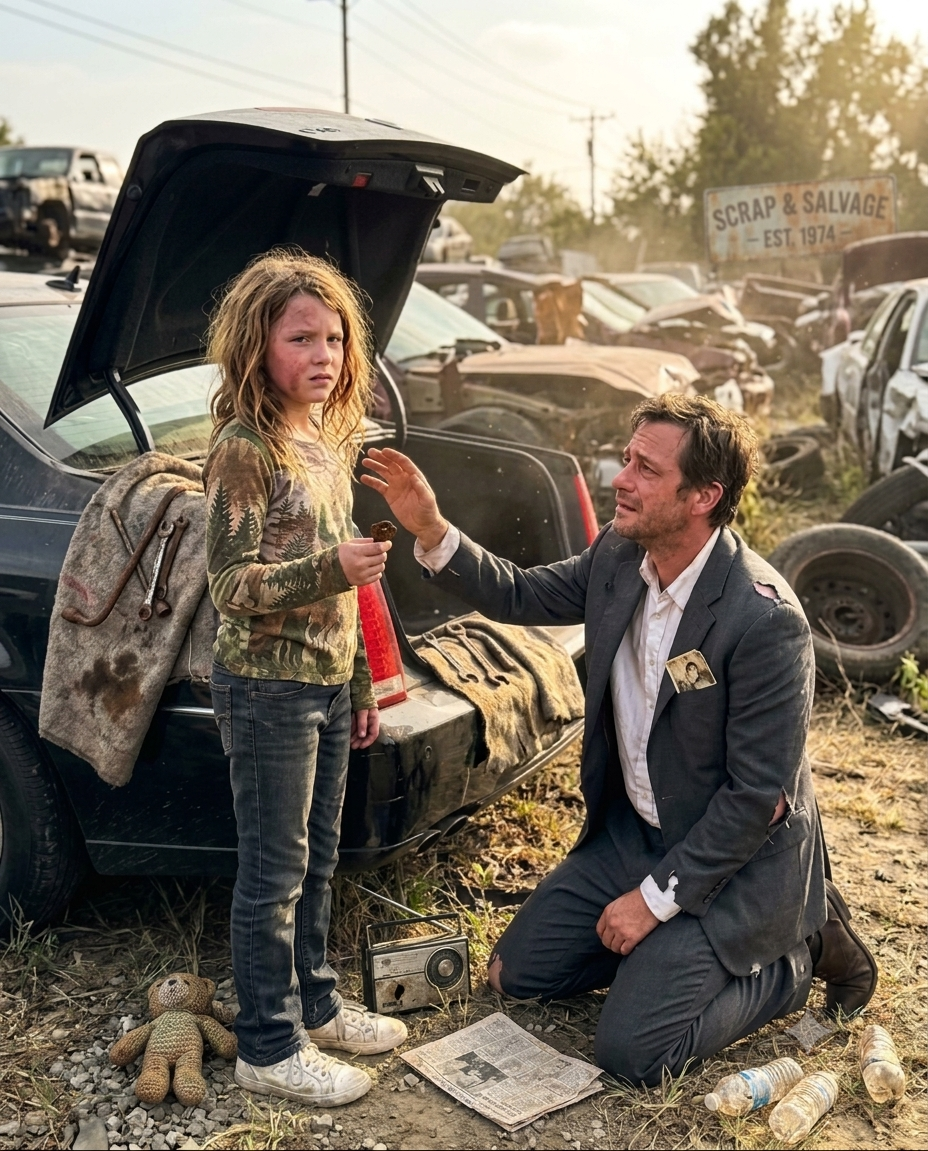
A dark port-wine stain spread across the left side of her face from temple to jaw, impossible to miss and impossible for strangers not to stare at. Some children were blunt enough to point. Some adults pretended not to notice, which somehow felt worse. Eleanor had grown used to the extra beat of silence when someone first looked at her.
Used to it did not mean immune to it.
It simply meant she had learned to carry the hurt quietly.
That afternoon began like any other.
Bright sun. Sharp wind. The metallic smell of heat rising from rusted hoods and old engine blocks. Somewhere deeper in the yard, chains clanked and a forklift beeped in lazy reverse. Ruth was inside the office trailer balancing invoices, and Mr. Donovan had gone to meet a tow driver out by the main road.
Eleanor wandered toward the back fence, where newer arrivals were usually left before being stripped for parts.
That was when she saw the sedan.
It did not belong there.
Even to a ten-year-old, the difference was obvious.
Most vehicles in the yard arrived wounded beyond pretending—paint peeled off, headlights gone, bumpers hanging like loose teeth. But this one was sleek and black, polished enough to reflect the sky. Its windows were deeply tinted. Its chrome still caught the light. It looked less like junk and more like it had been dropped there by mistake from some wealthier, shinier universe.
Eleanor slowed.
Something about it bothered her.
Not in a loud way. In a quiet one.
Like a sentence with the wrong ending.
She stepped around the rear of the car, studying the tires, the glossy paint, the expensive badge on the trunk. Her fingers hovered just above the surface without touching it. She had spent enough time in the yard to know which objects were harmless and which had sharp edges waiting to bite.
Then she heard it.
A heavy thud.
She froze instantly.
At first she thought something had fallen nearby—a loose panel, maybe, or a toolbox slipping from a stack. But then it came again.
Thud.
This time there was no mistaking it.
It came from inside the trunk.
Every muscle in Eleanor’s body went tight. The wind hissed through the chain-link fence behind her. Somewhere overhead, a gull let out a harsh cry. But everything else seemed to recede beneath the pounding in her ears.
She stared at the trunk.
Another blow struck from the inside, harder this time, followed by a muffled sound that was unmistakably human.
Someone was in there.
Her mouth went dry.
“H-hello?” she whispered.
The response was immediate.
Banging—faster now, more desperate. A muffled voice, trapped behind tape or cloth, forcing out sounds that weren’t quite words and were somehow even more terrifying because of that.
For one split second, she nearly ran.
She could get Ruth. She could scream for Mr. Donovan. She could do what children were supposed to do in frightening situations—find an adult and let them take over.
But there were no adults in sight.
And the sounds inside that trunk didn’t feel angry.
They felt terrified.
Eleanor moved closer, every step shaky and deliberate. She grabbed the trunk handle and pulled.
Locked.
Her heart slammed against her ribs. She yanked again, harder this time, but it didn’t budge.
She spun around, scanning the yard.
Nothing.
No workers nearby. No engines running close enough. Just wind, scrap, distance, and the awful truth that whoever was in that trunk had no one else.
“I’m here,” she called, her voice trembling. “I’m gonna help.”
She took off at a run.
Past a stack of dented truck beds. Past a row of stripped doors leaning like giant dominoes. Past the old shed where broken tools, twisted pipes, and unclaimed hardware were dumped in heaps. She nearly slipped on gravel as she dropped to her knees beside a pile of scrap and began digging with both hands.
Nails. A bent wrench. A saw blade too rusted to trust. Then finally—half-buried under a tire rim—a crowbar.
It was heavy, far heavier than anything a ten-year-old should have been hauling, but Eleanor dragged it free and staggered back toward the car, fighting the weight and the panic rising in her throat.
Inside the trunk, the pounding had grown weaker.
That frightened her most of all.
“I’m gonna try!” she shouted. “Hang on!”
She jammed the end of the crowbar into the seam of the trunk lid. Her hands slipped. She repositioned it and pulled with everything she had.
Nothing.
Tears stung her eyes. She clenched her jaw and tried again, feet braced in the dirt, arms shaking with effort.
The metal groaned.
Again.
She sucked in a breath and gave it every ounce of strength she had left.
This time the trunk screeched—and popped.
The lid sprang up just enough for her to grab it.
Inside was a man.
He was bound at the wrists and ankles with rope. Silver-gray duct tape covered his mouth. His expensive suit was wrinkled, stained, and torn at one shoulder. Bruises darkened one side of his face. Sweat clung to his hairline. He looked exhausted, disoriented, and dangerously close to the edge of collapse.
Yet even in that awful condition, there was something about him that still suggested power. Not arrogance exactly. More like the kind of ease expensive people carry without noticing. The kind that lingers even when everything else has been stripped away.
His eyes flew to Eleanor.
She dropped the crowbar and climbed closer, reaching with trembling fingers for the tape.
“It might hurt,” she whispered.
He nodded urgently.
She peeled it back.
He sucked in air with a rough, broken gasp, like a drowning man reaching the surface.
“Thank God,” he rasped. “Please… untie me. Quickly.”
Eleanor swallowed hard and began fumbling with the knots at his wrists. Her fingers were small and clumsy with nerves, but desperation made her persistent. Once she loosened enough rope, he managed to wrench one hand free, then the other. He tore the ropes from his ankles and slowly pulled himself out of the trunk.
For a second, he leaned against the car, breathing hard, one hand gripping the edge as though the ground itself had become unreliable.
He looked wildly around the yard, eyes sharp with alarm.
Then he looked at Eleanor.
Really looked at her.
And everything changed.
His gaze stopped at the birthmark on the left side of her face.
Eleanor felt the familiar twist inside her immediately. It was so automatic now that her hand rose to her cheek before she even thought about it. She took a small step back, her voice gentler than her fear.
“Are you okay?” she asked. “Do you want me to get my grandma? Or call the police?”
He didn’t answer.
His expression had gone strange.
Not disgusted. Not startled in the ordinary way people were startled.
Wounded.
Like the sight of her had reached inside him and torn open something old and unfinished.
His eyes filled.
The change was so sudden it made Eleanor wonder if he was in shock. But then, before she could say another word, the man lowered himself to his knees in the dirt in front of her.
Not carefully.
Not with dignity.
He just dropped there, like his legs could no longer hold the weight of what he was seeing.
One trembling hand lifted toward her face, then stopped inches away, hovering in the air as if touching her might shatter something too fragile to survive contact.
“What’s your name?” he asked.
His voice cracked on the last word.
“Eleanor,” she said quietly. “Eleanor Hayes.”
The man drew in a ragged breath.
“And how old are you?”
“Ten,” she said. “I’ll be eleven in February.”
He stared at her as though each answer confirmed something he had spent years not daring to imagine.
“Eleanor,” he repeated, almost to himself.
Then came the next question.
“And your mother?” he asked. “Where is your mother?”
The air around them seemed to shift.
Eleanor’s expression changed at once. Some answers were harder than others, no matter how many times you had to give them.
“She died when I was a baby,” she said softly. “It’s just me and my grandma Ruth.”
The man shut his eyes.
Not in thought. In pain.
His shoulders shook once, then again. And when he opened his eyes, they were overflowing. He bowed his head and began to cry.
Not politely.
Not the restrained tears adults usually hide from children.
This was something rawer than that.
He cried as if he had just found the wreckage of his own life waiting for him in the middle of a junkyard under the hot afternoon sun.
Eleanor stood frozen, unsure what to do.
She had never seen a grown man cry like that.
Not from fear.
Not from gratitude.
From grief.
His breath hitched. One hand covered his mouth. The other pressed into the dirt for balance. Eleanor glanced toward the office trailer, wishing fiercely for Ruth to appear and explain what was happening.
But they were alone.
Finally, the man lifted his face and looked at her again.
And then he said the name.
Her mother’s name.
He whispered it like a prayer and a wound at the same time.
Eleanor’s heart seemed to stop.
It was impossible.
That was the only word her mind could form.
Impossible.
No stranger should have known that name. Not here. Not like this. Ruth talked about Eleanor’s mother only rarely, and even then in fragments—as if the grief had edges too sharp to handle directly. Eleanor knew her mother had been young. Kind. Beautiful, people said. Gone too soon.
That was all.
So how could this bruised, trembling man in an expensive ruined suit know her name?
Eleanor took another small step back, confusion now pushing past fear.
“How do you know my mom?” she asked.
The man swallowed hard but didn’t answer immediately. He looked as though he were trying to decide which truth would hurt less.
Before he could speak, a voice sliced across the yard.
“Eleanor?”
Ruth.
Her grandmother came hurrying from the office, one hand gripping the trailer steps for balance before descending into the gravel. Even from a distance, Eleanor could see the alarm on her face. She had likely noticed Eleanor was gone too long and come looking.
Then Ruth saw the open trunk.
Saw the man.
Saw Eleanor standing beside him.
Everything in her posture changed.
She stopped so abruptly her shoes kicked dust forward.
The man looked up.
Ruth looked back at him.
And a silence passed between them that made Eleanor’s skin prickle.
Ruth’s face drained of color.
“No,” she said.
Just that one word.
No.
It was not disbelief. It was recognition.
“Ruth,” the man said hoarsely.
Eleanor turned sharply to her grandmother. “Grandma? You know him?”
Ruth did not answer right away. Her eyes stayed locked on the man’s face, moving over the bruises, the torn suit, the ropes still scattered at his feet. She seemed to be taking in not only who he was, but the fact that he was here at all.
Then she looked at Eleanor.
And Eleanor saw something there she had never seen before.
Fear.
Not fear of the man exactly.
Fear of what his presence meant.
“Eleanor, honey,” Ruth said carefully, her voice too calm in the way adults got when things were very much not calm, “go inside the office for a minute.”
“No,” Eleanor said at once. “He knows Mom’s name.”
Ruth shut her eyes briefly, as if bracing herself against a blow she had long expected and never truly prepared for.
The man got slowly to his feet, though he still looked unsteady. “She deserves the truth,” he said.
Ruth’s jaw tightened. “After ten years?”
His face flinched.
“I didn’t know,” he said. “God help me, Ruth, I didn’t know.”
The words hung there.
Eleanor’s gaze moved between them, trying to piece together a puzzle no child should have been handed without warning.
“What truth?” she whispered.
The wind picked up, rattling loose metal somewhere behind the fence. In the distance, a dog barked. The junkyard suddenly felt too open and too small all at once.
The man looked at Eleanor again, and when he spoke, his voice was unsteady but clear.
“My name is Gabriel Whitmore,” he said. “And I knew your mother a long time ago.”
Ruth let out a bitter breath. “That’s one way to put it.”
Gabriel glanced at her, shame crossing his features so plainly that even Eleanor could read it.
“I loved her,” he said.
Eleanor stared.
Loved her.
The word landed in her chest with strange weight. It didn’t make sense. It made too much sense. It made everything worse.
Ruth folded her arms tightly, perhaps to stop herself from shaking. “You disappeared,” she said. “She needed you, and you disappeared.”
Gabriel looked like he had been struck.
“I never left by choice.”
Ruth’s eyes flashed. “Then say it. Say where you were. Say why she buried herself under grief and silence while you built whatever empire got you tied up and stuffed in a car trunk.”
Empire.
The word caught Eleanor’s attention even through her confusion. She looked at the sedan again. At the suit. At the watch still clinging to Gabriel’s wrist.
Millionaire.
Boardroom man.
Magazine man.
And somehow tied to her dead mother.
Gabriel drew in a slow breath, but before he could answer, the sound of an engine rolled in from the road.
All three of them turned.
A black SUV appeared at the far end of the yard, too clean and too deliberate to belong among tow trucks and scrap haulers. It moved slowly over the gravel, then stopped.
The driver’s door opened.
A man in a dark suit stepped out, scanned the yard, and then hurried toward them with obvious urgency.
“Mr. Whitmore,” he called. “We’ve been looking everywhere—”
He stopped when he saw Eleanor.
Saw Ruth.
Saw the scene.
Gabriel straightened slightly, every trace of softness disappearing beneath instinctive control.
“Not now, Daniel.”
The man nodded once, instantly understanding he had walked into something larger than the kidnapping itself.
Kidnapping.
The reality of it hit Eleanor a second time.
Someone had tied this man up and locked him in a trunk. Someone dangerous. And now another man in a suit was here, which meant police, questions, trouble, change.
The kind of change people never recovered from quickly.
Ruth reached for Eleanor and drew her gently to her side. Gabriel watched the motion with an expression Eleanor could not name.
Longing, maybe.
Regret.
Or something even heavier.
“Take the car and call the police,” Gabriel said to the man. “No one touches anything until they arrive.”
Then he looked at Ruth again.
“I need to speak with you. Both of you.”
Ruth laughed once, and there was no humor in it. “You think you can just reappear and speak?”
“I think I owe her everything.”
Eleanor’s pulse beat loud in her ears.
Her.
Did he mean her mother?
Or Eleanor?
She looked up at Ruth. “Grandma… what is he talking about?”
Ruth’s mouth opened, then closed. Her eyes glistened unexpectedly, and that frightened Eleanor more than anything else. Ruth was not a woman who cried easily. Life had burned that softness out of her long ago.
But now she looked as if she were standing on the edge of a memory she had held shut for years.
The man called Daniel tactfully stepped away, already on his phone near the SUV. The junkyard, moments ago only a maze of metal and sun, had become a place where buried things were being forced into daylight.
Gabriel lowered himself again—not fully to his knees this time, but enough to meet Eleanor closer to eye level. His bruised face softened.
“I’m sorry,” he said. “For all the years I wasn’t there. For everything you don’t know yet.”
Eleanor’s throat tightened.
Adults only apologized like that when the truth underneath was huge.
Too huge.
She looked at his face and searched for something familiar there, though she wasn’t sure what she was looking for. A shape. An expression. A thread connecting him to a woman she barely remembered except through stories and one faded photograph tucked into Ruth’s dresser drawer.
The same photograph Ruth thought Eleanor had never found.
Her mother in a summer dress, laughing at something off-camera.
Young. Alive. Full of a future that had somehow vanished.
Eleanor’s voice came out almost as a whisper.
“Who are you to me?”
Gabriel’s eyes filled again.
For a moment, he could not speak.
Ruth turned away sharply, one hand over her mouth.
And when Gabriel finally answered, the whole world seemed to narrow to that single moment in the junkyard, under the hard afternoon light, beside the open trunk and the black sedan that had delivered the past straight to their feet.
“I think,” he said, his voice breaking, “I may be your father.”
The wind stopped feeling like wind after that.
It felt like silence.
Huge, ringing silence.
Eleanor did not move.
Did not blink.
Did not breathe.
Because some words are too large to fit inside a child all at once.
And as Ruth began to cry, and the distant wail of approaching sirens drifted toward the junkyard, Eleanor looked up at the man who had been locked in a trunk only minutes before and realized that being rescued was not the most shocking thing that had happened there that day.
Not even close.
Because the stranger she had saved might not have been a stranger at all.
And the truth about her mother—the one Ruth had hidden, the one Gabriel clearly carried like a wound—was only just beginning to surface.
What Eleanor heard next would change everything she thought she knew about her life…