

A British actress, known for her appearances in a television spin-off of EastEnders and a supporting role in a Jason Statham film, has become the focus of a major criminal investigation in Australia. The 34-year-old, identified in reports as Emaa Hussen, has been charged with allegedly attempting to import a large quantity of methamphetamine into the country. If convicted, she could face a maximum sentence of life imprisonment under Australian law.
Authorities allege that the case involves one of the most significant drug seizures in recent years, with an estimated street value reaching hundreds of millions of Australian dollars. The investigation has drawn attention both in Australia and abroad due to the scale of the operation and the suspect’s previous acting career.
How the Shipment Was Discovered
According to information reported by Australian authorities and cited by international media outlets, the case began in April when two shipping containers arrived at Sydney’s Port Botany from Ghana. The cargo documentation listed the contents as charcoal, a commonly exported commodity that can be used for heating, grilling, or industrial purposes.
However, border officials became suspicious after routine X-ray scanning revealed irregularities inside the containers. The imaging reportedly showed inconsistencies in density and structure that did not match normal charcoal shipments. This prompted Australian Border Force officers to conduct a more detailed physical inspection.
During the examination, investigators allegedly discovered white crystalline substances concealed deep within bags of charcoal. Subsequent testing reportedly confirmed that the substance was methamphetamine, a powerful and illegal stimulant drug.
Scale of the Alleged Operation
Authorities claim that the total quantity of methamphetamine found in the shipment was approximately 320 kilograms. This amount is considered extremely large by international drug enforcement standards and is believed to represent a significant attempted importation into Australia.
Officials have estimated the potential street value of the seized drugs at around A$296 million. Law enforcement agencies also stated that the quantity could have been broken down into millions of individual street-level transactions. Australian Federal Police representatives emphasized that the seizure likely prevented widespread distribution of the drug across local communities.
While such figures are estimates, they are commonly used by law enforcement to illustrate the potential impact of large-scale trafficking operations.
Controlled Delivery and Follow-Up Arrests
Rather than immediately confiscating and destroying the shipment, investigators reportedly chose to conduct what is known as a “controlled delivery.” This strategy involves allowing the shipment to continue to its destination under surveillance in order to identify individuals involved in the broader network.

In this case, authorities allegedly allowed the containers to be transported to a storage facility in Girraween, a suburb in western Sydney. Surveillance teams monitored the situation closely as events unfolded.
According to police claims, Emaa Hussen later arrived at the facility and was seen directing several men during the unloading process. Bags from the shipment were then allegedly moved into a vehicle and transported to a residential property in Blacktown.
It was at this point that law enforcement intervened. Hussen was arrested, and investigators reportedly seized electronic devices and a notebook believed to be relevant to the case. These materials are expected to undergo forensic analysis as part of the ongoing investigation.
Court Proceedings and Legal Status
Following her arrest, Hussen appeared before a Sydney court. She was denied bail and remains in custody while awaiting further legal proceedings. Her next scheduled court appearance is set for August, where additional evidence may be presented.
Under Australian law, the charge of importing or attempting to import a commercial quantity of a border-controlled drug such as methamphetamine carries extremely severe penalties. In the most serious cases, convictions can result in life imprisonment.
At this stage, however, all allegations remain unproven, and the accused is entitled to the presumption of innocence until a court reaches a final verdict.
Links to Acting Career
Reports have also highlighted that Hussen has a background in acting. She is said to have appeared in EastEnders: E20, a spin-off series of the long-running British soap opera EastEnders, which was launched in 2010.
She also reportedly had a role in the 2013 action thriller Hummingbird, a film starring Jason Statham that was released in some markets under the title Redemption. While her roles were not leading parts, her involvement in recognizable productions has contributed to increased media attention surrounding the case.
Official Responses
Australian law enforcement agencies have publicly praised the operation, describing it as a significant disruption to organized drug trafficking activity.
An Australian Federal Police spokesperson highlighted the scale of the alleged seizure, noting that removing such a large quantity of methamphetamine from circulation would have a substantial impact on local drug supply chains.
Similarly, officials from the Australian Border Force emphasized the sophistication of smuggling attempts encountered at the border. They stated that criminal networks often use complex concealment methods, including hiding drugs inside legitimate goods such as charcoal, textiles, or machinery, in an effort to evade detection.
However, they also stressed that advanced scanning technology and experienced officers continue to play a critical role in identifying suspicious shipments.
Broader Context of Drug Trafficking Concerns
This case comes amid ongoing efforts by Australian authorities to combat large-scale drug importation. Australia is considered one of the countries with the highest street value for illicit drugs, making it a key target for international trafficking networks.
Methamphetamine, in particular, remains a major focus for law enforcement due to its high potency, addictive nature, and widespread social impact. Authorities continue to invest in border security, intelligence sharing, and international cooperation to disrupt supply chains before drugs reach domestic markets.
Ongoing Investigation
The investigation is still ongoing, and authorities have not ruled out further arrests or charges connected to the case. Law enforcement agencies are expected to continue analyzing seized materials, including digital evidence, to determine whether additional individuals were involved in the alleged operation.
As the legal process continues, the case is likely to remain under close public and media scrutiny due to its scale, international links, and the profile of the accused.
Donald Trump Makes Strong Remarks on Possible Prison Sentence as Reflecting Pool Faces New Issue
 Recent reports surrounding the renovation of the Lincoln Memorial Reflecting Pool in Washington, D.C., have sparked public debate after allegations of vandalism and political statements made by former President Donald Trump. The reflecting pool, located between the Lincoln Memorial and the Washington Monument, is one of the most visited landmarks in the United States and has recently undergone a large-scale renovation project.
According to various reports, the renovation project was valued at approximately $14.7 million and involved cleaning, structural repairs, and restoration work on the historic site. However, shortly after completion, concerns were raised about the condition of the pool, including reports of algae formation and visible damage to sections of the newly applied surface material. Contractors involved in the project stated that some issues were minor and could be addressed under warranty agreements.
Allegations of vandalism soon followed, with claims circulating that the damage may have been caused intentionally. Some reports suggested that law enforcement had responded to incidents at the site, including citations and detentions. However, as of the latest available information, authorities have not publicly confirmed detailed evidence supporting claims of deliberate destruction of the pool’s structure.
 The Department of the Interior has stated that multiple police reports were filed in connection with incidents at the Reflecting Pool area. Officials also confirmed that citations were issued in several cases. However, specific evidence regarding the nature and extent of the alleged vandalism has not been fully disclosed to the public at this time.
Among the individuals mentioned in media coverage was a former Olympic athlete, who reportedly denied any wrongdoing and stated that his interaction with the site was misinterpreted. According to his account, he was detained after touching material that had already begun to peel from the surface, rather than actively causing damage.
Former President Donald Trump has publicly commented on the situation, claiming that acts of vandalism occurred at the site. In statements shared on social media and in press remarks, he alleged that individuals intentionally damaged parts of the reflecting pool. These claims have not been independently verified by publicly released evidence from federal authorities.
Trump further stated that destruction or attempted destruction of federal monuments could carry severe legal consequences, including potential prison sentences. He referenced penalties of up to 10 years for such offenses, emphasizing the importance of protecting national landmarks. These statements were made as part of his broader comments on the renovation and alleged incidents.
Federal authorities, including the U.S. Park Police and the Department of the Interior, have indicated that investigations and reviews are ongoing. Officials stated that citations issued over the weekend are still being evaluated and that decisions regarding potential charges will depend on the outcome of these reviews.
In public comments, a representative speaking on behalf of federal prosecutors noted that cases related to vandalism or damage to federal property would be taken seriously and processed through the appropriate legal system. However, no formal criminal charges related specifically to the Reflecting Pool allegations have been confirmed in court as of now.
The contractor responsible for the renovation project has stated that any observed damage appears limited in scope and is expected to be repaired under existing warranty provisions. They also indicated that routine maintenance and water treatment are part of ongoing management for the site, which can sometimes lead to temporary visual issues such as algae growth.
The situation has become a topic of political discussion, with differing interpretations of the causes and seriousness of the reported issues. While some statements suggest intentional damage, others emphasize the lack of publicly released evidence and ongoing nature of official reviews.
As investigations continue, authorities are expected to provide further clarification regarding the condition of the Reflecting Pool and the validity of vandalism claims. For now, the situation remains under review, and no final legal conclusions have been announced.
15 Common Everyday Objects With Hidden Uses You Probably Didn’t Know About
 Modern life is filled with objects we use automatically, without ever questioning their design. At first glance, many everyday items seem simple or even random in shape, but in reality, most of them are the result of decades—sometimes centuries—of practical engineering, safety testing, and user experience improvements. These small design decisions often go unnoticed, yet they quietly improve safety, convenience, and efficiency in ways most people never think about.
Understanding them not only changes how you see common objects but also highlights how much thought goes into things we take for granted. One of the most widely misunderstood design features is the small hole in the cap of a ballpoint pen. This is not related to ink flow or writing performance. Instead, it is a safety feature designed to reduce the risk of suffocation if a child accidentally swallows the cap. The hole allows a minimal amount of airflow through the cap, increasing the chance of survival while medical help is sought.
Although it is not a guarantee of safety, it is part of broader international safety standards aimed at reducing choking hazards in everyday products. This simple detail shows how even the smallest objects can be designed with life-saving intent.
In the kitchen, many tools contain hidden design logic that goes unnoticed. For example, the circular hole in the handle of many cooking utensils, such as ladles or spoons, is often used for hanging storage. However, in many kitchens it also serves a practical second function: it can hold utensils while cooking, helping reduce mess on countertops. Similarly, the indentation or ring markings on some utensils marketed as “portion guides” are not universal measurement standards, but in some designs they help estimate serving sizes for convenience. While not scientifically precise, these features aim to support portion control and ease of use in home cooking environments.
Another commonly discussed item is the familiar wooden spoon or pasta server with a hole in the center. Many people believe this is strictly for measuring a single serving of pasta, but in reality, it is more of a general cooking aid than a strict measurement tool. It allows water to drain more easily and can loosely help estimate portion sizes depending on pasta type, but it is not standardized across manufacturers. Still, it reflects a broader design principle: combining multiple functions into a single, simple tool to improve cooking efficiency.
Moving to packaging design, fast-food and takeaway containers often contain clever engineering. The iconic folded paper box used for Chinese takeout is a strong example of functional origami-style packaging. It is designed to securely hold food during transport, but it can also be unfolded into a flat plate. This reduces the need for extra dishes and makes eating more convenient in informal settings. This dual-purpose design is widely used because it is inexpensive, space-efficient, and practical for both restaurants and customers.
Another small but useful feature can be found in many bottles and beverage containers. Beer bottles, for example, often have long necks not just for aesthetics, but for functional grip control. The neck helps reduce heat transfer from the hand to the liquid, keeping drinks cooler for longer. Similarly, many plastic beverage caps and lids are designed with ridges or textured edges to improve grip and prevent slipping, especially when hands are wet or cold.
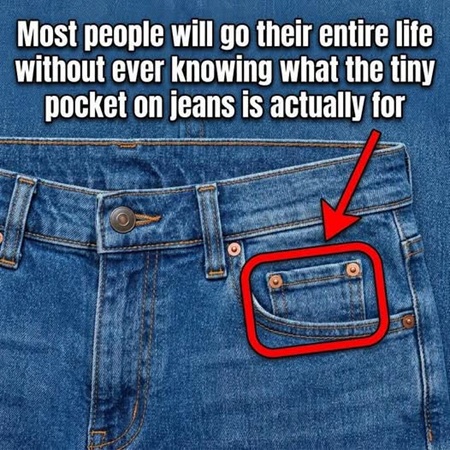
Clothing also contains subtle design elements rooted in history. The small extra pocket found inside the front pocket of jeans is one of the most well-known examples. This pocket dates back to the 19th century, when it was originally designed to hold pocket watches securely. Even though pocket watches are no longer commonly used, the design remains as a traditional feature in denim manufacturing. Today, it is often used for coins, keys, or small personal items, but its original purpose reflects the evolution of everyday fashion.
New garments often include a small fabric swatch attached to the clothing. Contrary to some online claims, this is not specifically meant for testing cleaning chemicals. Instead, it is primarily intended for color matching and fabric identification. It allows users to see how the material behaves under washing, ironing, or exposure to different conditions without damaging the actual garment. This small addition helps consumers make informed decisions about garment care.
Many wooden hangers, especially in older or higher-quality designs, are made from cedar or similar woods. Cedar naturally helps repel insects such as moths, which can damage wool and other natural fabrics. While not all modern hangers use cedar today, the tradition reflects a practical solution developed before modern synthetic storage solutions existed.
Vehicles also contain several subtle but important design features. One of the most useful is the small arrow next to the fuel pump icon on the dashboard. This arrow indicates the side of the car where the fuel tank is located, helping drivers quickly identify the correct side when refueling. This feature is especially helpful in unfamiliar vehicles or rental cars and is now widely standardized in modern automotive design.
Another commonly mentioned vehicle feature is the removable headrest. While it does provide comfort and safety during normal use, it is not primarily designed as a tool for breaking windows. In emergencies, the metal rods may be used to help escape a vehicle if doors are jammed, but dedicated safety tools are far more effective for window breaking. Automotive safety experts emphasize that while the headrest can be helpful in extreme situations, it should not be relied upon as the primary escape method.
Even small household items like padlocks include thoughtful engineering. The tiny hole near the keyway is not a defect. It is a drainage feature that allows water and moisture to escape, preventing rust and freezing in cold conditions. This helps ensure the locking mechanism continues to function reliably over time, especially when used outdoors in changing weather conditions.
Even paper itself contains subtle design history. The blank margins found on printed pages were originally developed for practical reasons such as preventing damage to text during binding, handling, or storage. In some historical contexts, margins also helped protect written content from wear caused by frequent use. Today, margins continue to improve readability and provide space for notes, annotations, or corrections.
Across all these examples, a common theme emerges: everyday objects are rarely as simple as they appear. Most are the result of long-term refinement, combining safety considerations, historical legacy, and user convenience. What may look like a random hole, groove, or shape is often the result of careful design choices intended to solve very specific problems.
When viewed from this perspective, the world becomes less ordinary and far more intentional. Even the most routine objects carry hidden logic that reflects human creativity and problem-solving. The next time you pick up a pen, open a food container, or get into your car, you are interacting with dozens of small design decisions that quietly improve your daily life without you even noticing.