Grief doesn’t always arrive loudly. Sometimes it settles quietly into your life, covering everything little by little until you no longer recognize the person you used to be, but you keep going anyway because stopping feels worse. That’s how it was for me after Emily died.
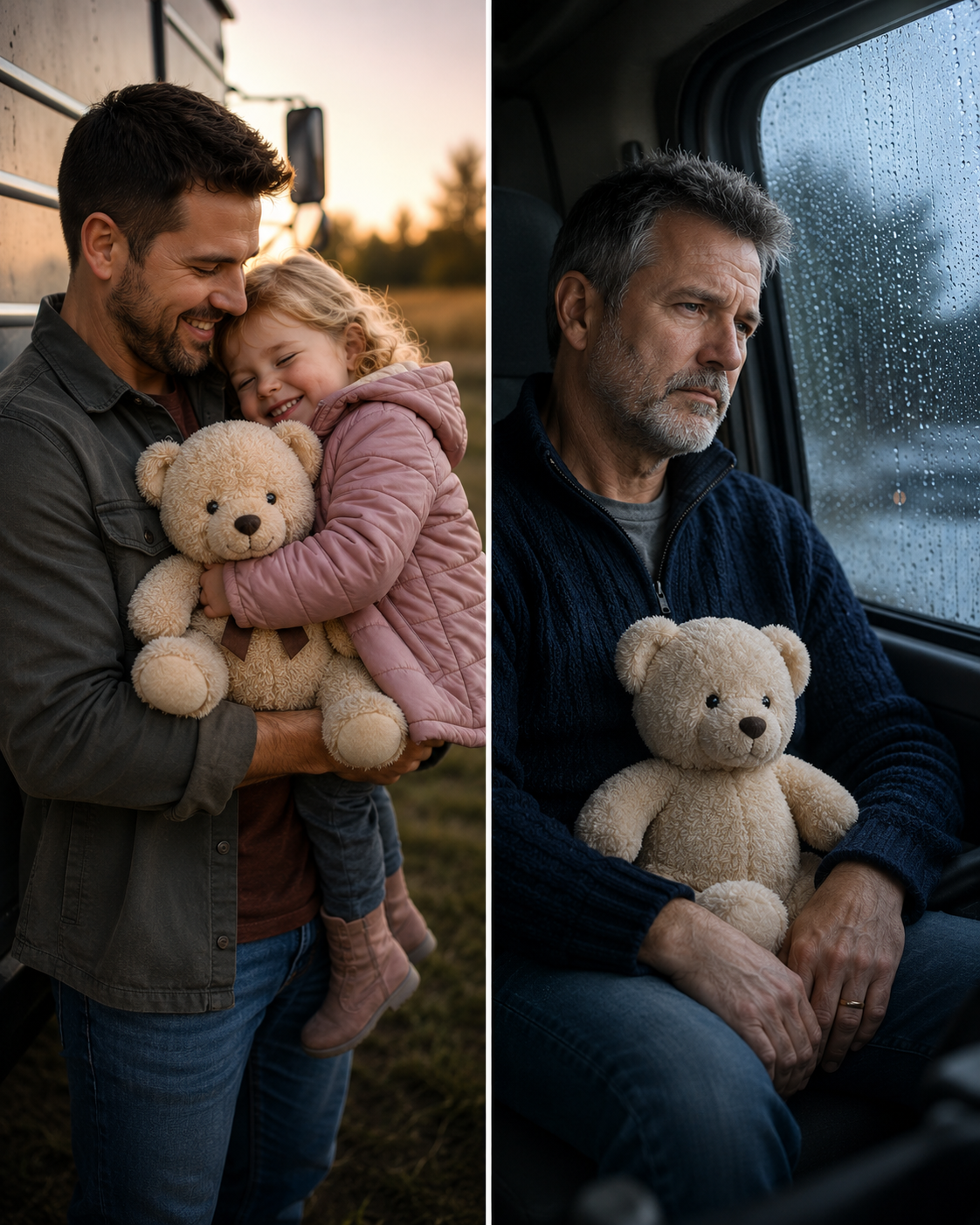
Before that, life had been simple in a way I didn’t appreciate enough. I was just a truck driver chasing miles, telling myself that working harder meant I was being a better father, while Emily only cared about the moments I didn’t realize I was missing. One day, she asked for a teddy bear as big as she was, and I found one at a dusty flea market, oversized and imperfect, with one eye slightly higher than the other. She hugged it like it was the most important thing in the world and named him Snow, and from that moment on, that bear became part of us.
Every trip I took, she made me buckle Snow into the passenger seat like he was alive, giving me strict instructions to keep him safe. At night, when the road stretched endlessly ahead, that ridiculous bear made the cab feel less empty, and when I came home, she would grab him back like she was reclaiming something important. I thought those moments would always be there, waiting for me when I returned.
Then life started slipping in ways I didn’t notice until it was too late. My marriage didn’t collapse in a dramatic way, it just wore down slowly under distance and silence until it finally ended. Emily learned how to live between two homes, smiling in both, but never fully belonging to either, and yet she never stopped handing me Snow before every trip like a quiet promise that something between us was still intact.

Then came the diagnosis, and everything changed in a way nothing could prepare me for. The hospital replaced our routines, machines replaced laughter, and time stopped meaning anything. But Emily refused to become a victim of what was happening to her, turning everything into a joke, naming equipment, making the nurses laugh, and still asking for Snow as if that small ritual could hold everything together.
One night, when the world felt too quiet, she made me promise something I didn’t want to promise. She told me to keep driving, to not stop living just because she might not be there, and I promised because I didn’t know how to say no to her. Two weeks later, she was gone, and that promise felt like something I couldn’t escape.
After the funeral, I did something I will never forgive myself for. I started erasing her. Not because I didn’t love her, but because loving her hurt too much to carry. I packed her things into bags, her drawings, her clothes, everything that made her real, and I told myself I was surviving when in reality I was running. The only thing I couldn’t throw away was Snow, because it didn’t hurt enough. It didn’t smell like her anymore, it didn’t break me, so I kept it like a version of grief I could control.
Years passed like that. I kept driving, kept moving, kept pretending I was fine because motion made it easier to avoid everything I didn’t want to feel. Then last week, something changed. I noticed the passenger seat empty and felt a panic I hadn’t felt in years, like I had lost something again. I went back inside, found Snow buried in the closet, and carried him out like I was apologizing to something that had been waiting for me.
When I set him down in the truck, I heard a crack. It was small, but wrong, and when I pressed the fabric, I felt something hidden inside. Back in my kitchen, I cut the seam open slowly, my hands shaking before I even understood why, and inside I found an envelope and a recorder, both addressed to me.
When I pressed play, I stopped breathing.
“Hi, Daddy.”
Her voice.

Not a memory, not something imagined, but real, alive, as if time had folded back on itself. She laughed softly and told me if I was hearing this, it meant I had finally found it, and then I heard Sarah’s voice too, my ex-wife, someone I hadn’t spoken to in years. Emily explained it like it was a game, a secret she had hidden because she knew me better than I knew myself.
“Dad acts tough,” she said, “but he breaks easy.”
That line shattered me in a way nothing else could, because she was right. She told me about a box buried in my yard, something she made for me because she knew one day I would need proof that she had been real, that our life had been real, that I hadn’t imagined everything I lost.
I didn’t think. I grabbed a shovel and started digging like I was chasing her voice through the ground. When I found the box, I hesitated, because I knew opening it would destroy whatever version of me I had left. But I opened it anyway.
Inside were photos. Not perfect moments, not staged memories, but real ones. Me asleep on the couch, us laughing at a diner, her holding Snow in a hospital bed, smiling like nothing was wrong. Proof that she had lived, that she had been happy, that I had been enough.

Then I read her letter.
“Dad, if you found this, you’re still here. Good.”
That was the moment I broke completely. Not quietly, not controlled, but in a way that stripped everything away. She told me those photos were for the nights I felt alone, so I would remember that what we had was real, that I wasn’t crazy for missing her, that she hadn’t disappeared into nothing.
And then the line that changed everything.
“Tell Mom you’re not mad.”

I sat there in the dirt, realizing I hadn’t been surviving all these years. I had been hiding. And she had known that before she even left.
That night, I called Sarah. Not because I was ready, but because Emily had asked me to. When she answered, I didn’t explain, I just said, “I found it.” She started crying immediately, and for the first time in years, we stopped pretending we were okay.
That’s when I understood something I had been running from for too long. Emily didn’t leave me with memories. She left me with instructions. Not to move on, but to keep living. Because grief doesn’t end your life. It only asks whether you’re willing to continue it.
Sometimes the people we lose understand us better than we ever understand ourselves. And sometimes, even after they’re gone, they still find a way to bring us back.